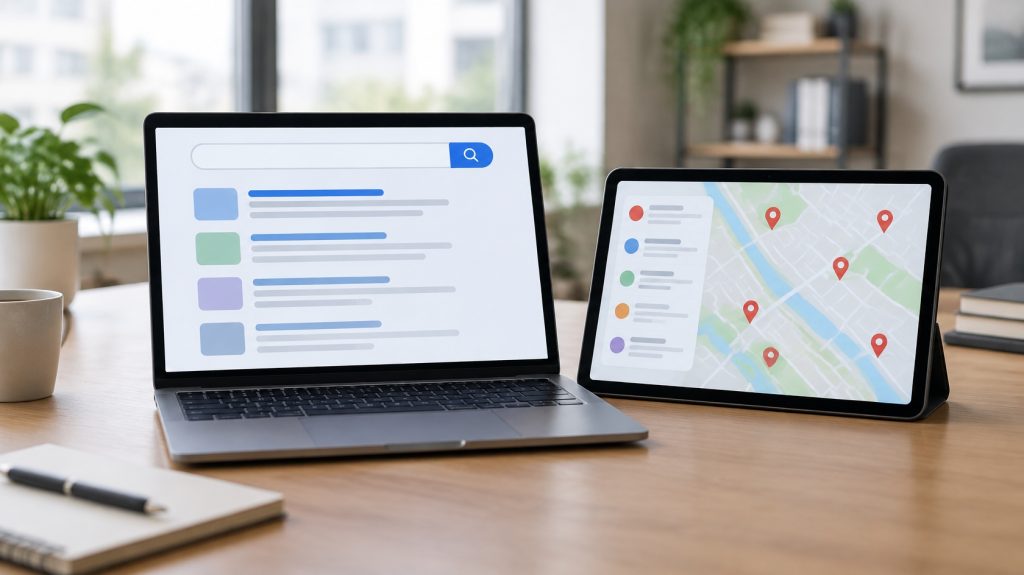


Most healthcare practices invest in a website and assume patients will find them. They won’t, not without the right local signals in place. Local SEO strategies for healthcare providers close that gap between a great practice and the patients actively searching for it nearby.
Introduction
Search behavior has changed dramatically. Patients no longer rely on a friend’s recommendation or a physician referral as their first step. They open Google, type a condition or specialty, and choose from what appears in the map pack. If your practice isn’t visible there, a competitor gets the appointment.
Local SEO strategies for healthcare providers address this reality directly. They help practices appear in the right searches, at the right moment, for the right patients. The stakes are concrete: practices that dominate local search capture patients who are already motivated to book.
This matters across every specialty. From primary care to elective procedures, the decision journey now starts online. Getting local visibility right is not a marketing luxury. It’s a patient acquisition necessity.
What Local SEO Means for Healthcare Providers
Local SEO is the discipline of making a healthcare practice visible to patients searching for care nearby. It differs from general website optimization because it targets geography-specific intent, the patient who needs a provider close to home, not just information about a condition.
According to NetOneClick, 71% of patients now find doctors through online search, surpassing physician referrals. A Direction.com study of 102,392 healthcare leads found that Google Business Profile local search accounts for 29.4% of all leads, up 6.95% year over year. Local visibility is now the primary patient acquisition channel.
How Local SEO Differs From Organic SEO
Local SEO and organic SEO run on separate algorithms with different ranking signals, which means the tactics that improve one do not automatically improve the other. Practices that treat them as identical often invest in the wrong work. Understanding the distinction helps allocate effort toward the signals that actually move local rankings.
Key differences include:
- Algorithm focus: Local SEO ranks on Google Business Profile completeness, reviews, and proximity. Organic SEO ranks on E-E-A-T signals, content depth, and backlinks.
- Search surface: The Google Map Pack drives approximately 44% of US healthcare “near me” click traffic, more than organic results and paid ads combined.
- Timeline: Local SEO improvements often show results in 30 to 90 days. Competitive organic rankings typically take 6 to 12 months.
- AI Overview exposure: According to MIS Services, 44.1% of medical queries trigger an AI Overview. Local provider queries receive zero, making local SEO the safest high-intent channel.
Why Local SEO Matters for Medical Practices
Local SEO matters for medical practices because patients search with clear intent and act fast, making top local visibility directly tied to appointment volume. The practices that appear prominently when a patient searches win that appointment. Those that do not show up rarely get a second chance.
The data makes the case directly:
- Search volume: “Near me” searches for healthcare services have grown 200% in two years, with 63% of US patient searches now including a location qualifier.
- Speed to action: According to Revenue Boomers, 88% of patients who search for a local provider visit or call within 24 hours.
- Map pack dominance: The top three map listings capture approximately 70% of clicks for local medical searches, and 60% of those searches end without any website visit.
- Elective medicine: More than 90% of cosmetic patients research online before a consultation, and 63% prefer a surgeon located close to home.
- Competitive gap: 52% of hospital websites lack optimized local SEO, leaving substantial patient volume available to practices that act.
7 Local SEO Strategies That Drive Patient Appointments
Seven coordinated local SEO strategies drive patient appointments by addressing the signals that matter most to both search engines and patients. No single tactic is sufficient on its own. Strong local visibility requires consistent effort across several channels working together to build authority and relevance.
Optimize Your Google Business Profile
Your Google Business Profile (GBP) is the single most influential local ranking asset. According to practicebeat.com, listings with complete GBP information get 7 times more clicks than incomplete profiles, and 48% of patients are more likely to choose a provider with a complete profile.
GBP signals account for approximately 32% of local pack ranking weight, per SearchAtlas and Whitespark. Selecting the wrong primary category is the single most damaging negative ranking factor. Consistent posting matters too. A study across 150 healthcare GBP profiles found consistent posting drove a 94% increase in generative AI search traffic and a 79% increase in appointment page sessions within 30 days.
Build Location-Specific Landing Pages
Generic service pages don’t capture geography-specific searches. Dedicated location pages do. Medical practices with location-optimized content see a 34% increase in organic traffic, and facilities with “near me” optimized pages receive 50% more appointment bookings.
For elective practices, procedure-specific local pages carry significant volume. Rhinoplasty drives roughly 90,000 US searches per month, liposuction around 83,000, and tummy tuck around 62,000. Each procedure deserves its own locally optimized page, not a shared services overview.
NAP Consistency and Local Citations
NAP (name, address, phone number) consistency across directories is a foundational local ranking signal, and getting it right is one of the highest-leverage steps a practice can take. Inconsistencies suppress visibility in local search results and erode patient trust at the same time, creating two problems from a single error.
How to Audit and Fix Citation Errors
Start with a full citation audit across the top healthcare directories. According to BrightLocal and Yext via causalfunnel.com, 65% of US medical practices have at least one inconsistent NAP citation across the top 20 directories, and 56% have incorrect contact information on Google itself.
Practices with consistent NAP across 25 or more directories rank 2.4 positions higher in the Local Pack. A healthcare practice that resolved NAP inconsistencies saw a 30% improvement in local rankings and a 20% increase in patient appointments within six months. Even minor formatting differences, “Suite 200” versus “#200,” can suppress rankings.
Earn Local Backlinks for Healthcare Authority
Local backlinks signal geographic relevance and domain authority to search engines. For plastic surgery and elective practices, high-value citation sources include RealSelf, Healthgrades, Vitals, Castle Connolly, ASPS member directories, and state medical board directories.
The patient behavior data reinforces why this matters. According to Geek Powered Studios, 92% of plastic surgery patients choose practitioners within 15 miles of their location. Local authority signals help practices appear for exactly those proximity-driven searches.
Online Reviews and Healthcare Local SEO
Online reviews influence healthcare local SEO because they function as both a ranking signal and a conversion lever at the same moment. The algorithm weighs review volume, recency, and sentiment while the patient reads those same reviews to decide whether to book. Practices that manage reviews actively gain on both fronts.
HIPAA-Compliant Review Responses
Responding to reviews builds trust without disclosing protected health information. According to Tebra and ReviewTrackers, businesses replying to 90% or more of reviews see 23% more profile views and 18% more direction requests than those replying to fewer than half.
Responses to negative reviews carry particular weight. 70% of patients viewed a provider more favorably after seeing a thoughtful reply to a critical review. Keep responses general, empathetic, and free of any patient-specific detail.
Managing Your Online Reputation
Review volume and rating directly affect both rankings and patient choice. According to RepuGen, 75% of patients now refuse to book with a provider rated below 4.0 stars. Review signals account for 33.4% of ranking impact in the health sector Local Pack.
The operational fix is straightforward. According to Tebra, 47% of patients are most likely to submit a review within one day of their appointment. A structured, timely review request system captures that window before it closes.
Medical Schema Markup for Local Search
Schema markup tells search engines and AI tools exactly what your practice offers, who your physicians are, and what conditions you treat, giving them structured data they can act on immediately. That clarity translates into stronger local search presence and is one of the fastest competitive advantages available right now.
Only 12% of US medical practice websites currently deploy proper medical schema markup, including MedicalBusiness, Physician, and MedicalProcedure JSON-LD types. Yet pages with schema-driven rich results have an 82% higher click-through rate than pages without. For AI-generated search experiences, the advantage compounds. According to BrightEdge, AI Overviews cite doctor-bylined pages 4 to 7 times more often than unsigned pages on medical queries. Adding reviewedBy and lastReviewed schema fields strengthens those entity signals directly. FAQPage schema is the baseline implementation for any YMYL healthcare page, unlocking expandable rich results and improving citation potential in AI-generated summaries.
Conclusion
Local SEO is no longer a secondary marketing consideration for healthcare practices. It’s the primary channel through which patients discover, evaluate, and choose a provider. The practices that invest in structured, consistent, and authoritative local signals will capture the patients who are already searching.
The opportunity is clear. Most healthcare websites have significant local SEO gaps, which means the competitive advantage for practices that act is substantial. Stronger visibility across search, map results, and AI-generated search experiences translates directly into better lead quality, more appointments, and more efficient patient acquisition over time.
Frequently Asked Questions
How much does local SEO cost compared to paid ads for a medical practice in the United States?
Local SEO in the United States typically runs an organic cost per lead of $40 to $90, compared to $120 to $200 or more for paid search, according to FoundryCRO. Over a 12-month period, the average cost per patient acquisition through SEO runs 61% lower than paid advertising. For practices with limited budgets, local SEO delivers a stronger long-term return than paid channels.
How does local SEO performance differ across healthcare specialties in the United States?
Performance varies by specialty and search intent. For dental practices in the United States, the Map Pack receives 42% of all local dental search clicks, per BrightLocal. For eye care, 76% of patients search online before booking an exam, yet 73% of eye care practices have incomplete local SEO profiles. Practices with optimized local SEO in the eye care category generate three times more new patient calls than those without.
What is the most important technical ranking factor for healthcare local SEO?
GBP signals account for approximately 32% of Local Pack ranking weight, followed by reviews at roughly 20% and on-page signals at 15%, per BrightLocal and Whitespark. Schema markup amplifies those signals further. Medical websites with structured data see a 25 to 35% increase in click-through rates, and 42% of healthcare websites currently lack proper schema implementation.
How does local SEO compare to paid search for elective and cosmetic practices?
Local SEO outperforms paid search on both cost and conversion for elective practices. Search engines generate three times more patient leads than referrals for plastic surgery practices, according to First Page Sage. Organic conversion rates for plastic surgery SEO reach 18.9%, compared to 10.7% for paid search. Patient acquisition cost via SEO runs approximately $200, versus $610 or more through Google Ads.
How long does it take to see results from local SEO for a medical practice?
GBP improvements and Map Pack movement typically appear within 30 to 90 days. NAP inconsistency corrections show an average ranking improvement of roughly 17% within 90 days, per practicebeat.com. Competitive procedure keyword rankings take 6 to 12 months. True Sports Physical Therapy implemented local SEO enhancements including GBP “Book Now” buttons and saw a 150% increase in evaluations, generating $2.4 million in customer lifetime value from a $315,000 investment.